Math 135: Toolkit 🧰
This toolkit contains all of the definitions, properties, laws and theorems you need to memorize all on one webpage. These are your tools on quizzes and exams.
It also contains the Desmos animations we have seen in class!
Table of Contents
- Desmos Animations
- Chapter 0
- Chapter 1
-
Chapter 2
- 2.0: The Tangent Line
- 2.1: Limits and Continuity
- 2.2: The Derivative
- 2.3: Sum and Power Rules
- 2.4: Product and Quotient Rules
- 2.4$\frac{1}{2}$: Business and Economics Applications of the Derivative
- 2.5: The Chain Rule
- 2.5$\frac{1}{2}$: Higher Order Derivatives
- 2.6: Increasing/Decreasing Functions and Concavity
- 2.7: Optimization
- 2.9: Applied Optimization and Elasticity
- 2.11: Implicit Differentiation and Related Rates
- Chapter 3
Desmos Animations
How to Interact with Animations
- Drag sliders around to see animations!
- Click on folders/squiggly lines to the left of each block to turn off/on each block.
- If you are curious, you can expand each folder to see how each animation was created!
- If you do change a slider/graph, when leaving the webpage, you'll be prompted with "do you want to leave this page?" You can just leave; closing Desmos will ask you this everytime.
2.0: The Tangent Line
In 2.0: The Tangent Line, we saw the secant to tangent intuition by letting $h$ get as close as we want to $0$.
2.2: The Derivative
In 2.2: The Derivative, we saw the slopes of tangent lines tracing out the graph of the derivative.
For $f(x) = x^3 - 4x^2$:
For $f(x) = \dfrac{1}{x}$:
3.1: The Definite Integral
In 3.1, we saw how to calculate the exact area between the curve $f(x) = x^2$ and the horizontal axis on $[0, 1]$. The following animation uses left endpoints for rectangles and lets the number of rectangles grow without bound:
Letting $n\to\infty$, it seems $\displaystyle\int^1_0 x^2 \ dx = \dfrac{1}{3}$.
Chapter 0: Fundamentals
0.1: Be Aware
Terms are expressions separated by subtraction and addition.
Factors are expressions separated by multiplication.
Global context refers to the context of the entire expression.
Local context refers to a context smaller than the entire expression.
0.2: Be Precise
-
$\dfrac{a}{b}\cdot \dfrac{c}{d} = \dfrac{ac}{bd}$
English Multiplying fractions requires multiplying global context of the numerators and global context of the denominators. -
$\dfrac{a}{b}\div \dfrac{c}{d} = \dfrac{a}{b}\cdot \dfrac{d}{c}$
English Dividing fractions requires taking the reciprocal of the right fraction, then multiplying. -
$\dfrac{a}{c} + \dfrac{b}{c} = \dfrac{a + b}{c}$
English Adding fractions with the same denominator requires adding the global context of the numerators together. - $\dfrac{a}{b} + \dfrac{c}{d}\qquad $ Find the LCD (getting the same denominator), then use Property 3.
-
$\dfrac{ac}{bc} = \dfrac{a}{b}$
English Cancelling an expression $c$ requires the expression to be a global factor in both the numerator and denominator.
Let $a, b, c$ be real numbers.
- Commutative Properties
- $a + b = b + a$
- $ab = ba$
English Can swap terms with terms and factors with factors. - Associative Properties
- $(a + b) + c = a + (b + c)$
- $(ab)c = a(bc)$
English Can swap evaluation priority among all terms or among all factors. - Distributive Property
- $a(b + c) = ab + ac$
- $(b+c)a = ab + ac$
English The only way factors and terms interact.
- $-a = (-1)a$
- $-(-a) = a$
- $(A + B)(A - B) = A^2 - B^2$
- $(A + B)^2 = A^2 + 2AB + B^2$
- $(A - B)^2 = A^2 - 2AB + B^2$
- Identify all the terms (usually global).
- Identify the factors the terms have in common (the GCF).
- Factor out the common factor and write in the factor structure of the distributive property.
- Generate candidates for $a$ (left column product, all possibilities of two numbers that multiply to $a$).
- Generate candidates for $c$ (right column product, all possibilities of two numbers that multiply to $c$).
- Choose the right candidates by checking the cross-product and sum against $b$.
- $A^2 - B^2 = (A-B)(A+B)$
- $A^2 + 2AB + B^2 = (A+B)^2$
- $A^2 - 2AB + B^2 = (A-B)^2$
- Find exclusions. Exclusions are:
- Taking the square root of an expression that is negative.
- Dividing by an expression equal to zero.
- Remove exclusions: Solve the equations/inequalities in step 1, and remove the solutions from all real numbers. Write in interval notation.
- $x^ax^b = x^{a+b}$
- $\dfrac{x^a}{x^b} = x^{a-b}$
- $(x^a)^b = x^{a\cdot b}$
- $(xy)^a = x^ay^a$
- $\left(\dfrac{x}{y}\right)^a = \dfrac{x^a}{y^a}$
- $a_n, a_{n-1}, \dots, a_1, a_0$ are called the coefficients
- degree: largest power of the independent variable
- $a_nx^n$ is called the leading term
- $a_n$ is called the leading coefficient
- Domain: $\mathbb{R}$
- Range: depends (on the degree).
- Graph is smooth (no corners or sharp corners) and continuous (no breaks or holes).
- Domain $\mathbb{R}$
- Range $(0, \infty)$
- $y$-intercept: $y = a$
- As $x\to \infty, f(x) \to \infty$
- As $x\to -\infty, f(x) \to 0$
- Horizontal asymptote: $y = 0$
- $P_0 = $ initial amount
- $r = $ growth rate (as a decimal)
- $t = $ time
- $P(t) = $ amount after time $t$
- $P_0 = $ initial amount
- $r = $ continuous growth rate (as a decimal)
- Common logarithm (base 10): $\log(x) = \log_{10}(x)$
- Natural logarithm (base $e$): $\ln (x) = \log_e(x)$
- Domain $(0, \infty)$
- Range $\mathbb{R}$
- Vertical asymptote: $x = 0$
- $x$-intercept: $x = 1$
- As $x\to 0^+, f(x) \to -\infty$
- As $x\to \infty, f(x) \to \infty$
- Constant Multiple Rule: $\dfrac{d}{dx}(c \cdot f(x)) = c\cdot \dfrac{d}{dx}(f(x))$
Pull out constants and focus on the function.
- Sum/Difference Rule: $\dfrac{d}{dx}(f(x) + g(x)) = \dfrac{d}{dx}(f(x)) + \dfrac{d}{dx}(g(x))$Also true for $f(x) - g(x)$. Derivative splits across terms.
- Power Rule: $\dfrac{d}{dx}(x^n) = n\cdot x^{n-1}$
- Special Case: $\dfrac{d}{dx}(c) = 0$
- Special Case: $\dfrac{d}{dx}(x) = 1$
- Exponential Functions
- $\dfrac{d}{dx}(e^x) = e^x$
- $\dfrac{d}{dx}(a^x) = a^x\cdot \ln(a)$
- Natural Logarithm: $\dfrac{d}{dx}(\ln(x)) = \dfrac{1}{x}$
- Revenue is the total money value of the goods/services sold by a business.
- Cost is the expenses incurred to generate revenue.
- Fixed costs are costs that do not depend on the number of goods/services sold, such as rent or salaries of your employees.
- Variable costs are costs that depend on the number of goods/services sold, such as bulk product costs to create your products.
- Profit is the difference between revenue and cost: $\text{revenue } - \text{ cost}$.
- Given a revenue function $R(q)$ and a cost function $C(q)$, the profit function is $P(q) = R(q) - C(q)$.
- Given a revenue function $R(q)$, the marginal revenue at $q$ items produced is $R'(q)$.
- Given a cost function $C(q)$, the marginal cost at $q$ items produced is $C'(q)$.
- Given a profit function $P(q)$, the marginal profit at $q$ items produced is $P'(q)$.
- The first derivative is $f'(x)$.
- The second derivative is written as $f''(x)$, which is the derivative of $f'(x)$. $f''(x) = \dfrac{d}{dx}(f'(x))$
- The third derivative is written as $f'''(x)$, which is the derivative of $f''(x)$. $f'''(x) = \dfrac{d}{dx}(f''(x))$
- Continuing this process, the nth derivative is written as $f^{(n)}(x)$, which is the derivative of the $n-1$st derivative $f^{(n-1)}(x)$.
- If $f'(x) > 0$ for all $x$ in $(a, b)$, then $f(x)$ is increasing on $(a, b)$.
- If $f'(x) < 0$ for all $x$ in $(a, b)$, then $f(x)$ is decreasing on $(a, b)$.
- Find the derivative of $f(x)$.
- Find the critical numbers of $f(x)$, meaning:
- Find the $x$-coordinates where $f'(x) = 0$ or $f'(x)$ is undefined (DNE)
- Draw a sign diagram of $f'(x)$, and determine the sign of $f'(x)$ at one test value in each of the intervals created by critical numbers.
- Use the Increasing/Decreasing Test to decide what intervals $f(x)$ is increasing/decreasing on.
- If $f''(x) > 0$ for all $x$ in $(a, b)$, then the graph of $f(x)$ is concave upward on $(a, b)$.
- If $f''(x) < 0$ for all $x$ in $(a, b)$, then the graph of $f(x)$ is concave downward on $(a, b)$.
- Find the second derivative of $f(x)$.
- Find the inflection points of $f(x)$, meaning:
- Find the $x$-coordinates where $f''(x) = 0$ or $f''(x)$ is undefined (DNE)
- Draw a sign diagram of $f''(x)$, and determine the sign of $f''(x)$ at one test value in each of the intervals created by $x$-coordinates of inflection points.
- Use the Concavity Test to determine the intervals of concavity for $f(x)$.
- $f(c)$ is a local maximum of $f$ when there exists an interval $(a, b)$ containing $c$ such that $f(c) \geq f(x)$ for all $x$ in $(a, b)$.
- $f(c)$ is a local minimum of $f$ when there exists an interval $(a, b)$ containing $c$ such that $f(c) \leq f(x)$ for all $x$ in $(a, b)$.
- Find the derivative of $f(x)$.
- Find the critical numbers of $f(x)$.
- For each critical number, examine the sign of $f'(x)$ to the left and right of $c$:
- If $f'(x)$ changes from positive to negative at $x = c$, then $f(x)$ has a local maximum at $(c, f(c))$.
- If $f'(x)$ changes from negative to positive at $x = c$, then $f(x)$ has a local minimum at $(c, f(c))$.
- If $f'(x)$ does not change sign at $x = c$, then $(c, f(c))$ is neither a local minimum nor maximum.
- If $f''(c) > 0$, then $f(c)$ is a local minimum.
- If $f''(c) < 0$, then $f(c)$ is a local maximum.
- If $f''(c) = 0$, then the test fails. In this case, use the First Derivative Test on the critical number $c$.
- $f(c)$ is a global maximum of $f$ if $f(c) \geq f(x)$ for all $x$ in the domain of $f$.
- $f(c)$ is a global minimum of $f$ if $f(c) \leq f(x)$ for all $x$ in the domain of $f$.
- Find the critical numbers of $f$ in the open interval $(a, b)$.
- Evaluate $f$ at each of the critical numbers.
- Evaluate $f$ at each endpoint (meaning, find $f(a)$ and $f(b)$).
- The least of these is the global minimum, and the greatest is the global maximum.
- Translate the English into a picture. Identify all given quantities and all unknowns.
- Write a primary equation for the quantity that is to be maximized or minimized.
- Reduce the primary equation to an equation with one independent variable. You may need to use a secondary equation, then substitute.
- Identify the feasible domain of the primary equation in the context of the problem.
- Find the maximum/minimum value using techniques from 2.6.
- If $f''(x) > 0$ on the domain of $f(x)$, then $f(c)$ is both a local and global minimum.
- If $f''(x) < 0$ on the domain of $f(x)$, then $f(c)$ is both a local and global maximum.
- If $E < 1$, demand is inelastic. Raising prices increases revenue.
- If $E > 1$, demand is elastic. Raising prices decreases revenue.
- If $E = 1$, demand is unit elastic. Revenue is at a maximum.
- Assume $y = f(x)$ (that is, $y$ is a differentiable function of $x$).
- Differentiate both sides with respect to $x$. Use the Chain Rule: every time you differentiate a term involving $y$, multiply by $y'$.
- Isolate $y'$: collect all $y'$ terms on one side, GCF factor out $y'$, then divide.
- Identify all quantities that change over time, and the rate you're trying to solve for.
- Find an equation relating the quantities in Step 1 (usually given).
- Differentiate both sides with respect to time $t$ (use the Chain Rule).
- After completing Step 3, plug in all given information. Then solve for the desired rate of change.
- $\Delta x = \dfrac{b - a}{n}$ is the width of one rectangle.
- $x_i$ is any number in the subinterval $[x_{i-1}, x_i]$ (typically a left or right endpoint).
- $\Delta x = \dfrac{b - a}{n}$ is the width of one rectangle.
- $x_i = a + i \cdot \Delta x$ is the right endpoint of the $i$th rectangle.
- $\displaystyle\int$ means "add up smaller and smaller width rectangles"
- $f(x)$ is the height of one rectangle
- $dx$ is the width of one rectangle
- $a$ and $b$ are the bounds of the interval $[a, b]$
- If $f(x)$ is above the horizontal axis, the area is positive.
- If $f(x)$ is below the horizontal axis, the area is negative.
- The integral and derivative are inverse processes; each undoes what the other has done.
- The rate of change of the area underneath the curve $f(t)$ with respect to the right bound of i ntegration is the value of the function at the right boundary.
- This theorem guarantees the existence of an antiderivative of $f(t)$, which is $g(x)$.
- Constant Multiple Rule: $\displaystyle\int c\cdot f(x) \ dx = c\int f(x) \ dx$
Pull out constants when integrating.
- Sum/Difference Rule: $\displaystyle\int\left(f(x)\pm g(x)\right) \ dx = \int f(x) \ dx \pm \int g(x) \ dx$The integral (definite/indefinite) splits across terms.
- Power Rule: $\displaystyle\int x^n \ dx = \dfrac{x^{n+1}}{n+1} + C$
- Special Case: $\displaystyle\int 0 \ dx = C$
- Special Case: $\displaystyle\int 1 \ dx = x + C$
- Exponential Functions
- $\displaystyle\int e^x \ dx = e^x + C$
- $\displaystyle\int a^x \ dx = \dfrac{a^x}{\ln(a)} + C$
- Natural Logarithm: $\displaystyle\int \dfrac{1}{x} \ dx = \ln\lvert x \rvert + C$
- Generally, $u$ is the inside of the composition. If you can identify any composition, try picking $u$ to be the inside function first.
- With a fraction, try the denominator as $u$ and check if $du$ matches the numerator.
- Try multiple $u$'s. You will know you picked the right $u$ when you can replace $x$ and $dx$ entirely with $u$'s.
- Try to choose $u$ that simplifies when differentiated.
- Try to choose $dv$ where either:
- $dv$ has a basic integration rule when integrated, or
- $dv$ simplifies when integrated.
- $\displaystyle\int \dfrac{1}{x^2 - a^2} \, dx = \dfrac{1}{2a} \ln\left\lvert \dfrac{x - a}{x + a} \right\rvert + C$
- $\displaystyle\int \dfrac{1}{\sqrt{x^2 + a^2}} \, dx = \ln\left\lvert x + \sqrt{x^2 + a^2} \right\rvert + C$
- If $x^n$ and $\ln(x)$ are present as factors, use IBP with $u = \ln(x)$.
- If $x^n$ and $e^x$ are present as factors, use IBP with $u = x^n$.
- If the integrand is a composition (inside/outside structure), try $u$-sub first.
- This area is never negative, even if both $f(x)$, $g(x)$ are below the $x$-axis.
- If the curves cross on $[a, b]$, split the integral at the crossing point(s), and set up each piece with the correct top and bottom.
- This computes net geometric area (always $\geq 0$). In contrast, $\int^b_a f(x)\ dx$ computes net signed area between the curve and the $x$-axis.
- Consumer surplus measures how much consumers saved by purchasing at the equilibrium price: \[CS = \int^{q^*}_0 \left(D(q) - p^*\right) dq\]
Consumers to the left of $q^*$ would have been willing to pay a higher price than $p^*$.
- Producer surplus measures how much producers gained by supplying at the equilibrium price: \[PS = \int^{q^*}_0 \left(p^* - S(q)\right) dq\]
Producers to the left of $q^*$ would have been willing to accept a lower price than $p^*$.
- Total income: $\displaystyle\int^T_0 F(t) \, dt$
Adds up all income received without accounting for the time value of money.
- Present value: $\displaystyle\int^T_0 F(t) \cdot e^{-rt} \, dt$
How much the future income stream is worth right now (why it is called present value).
0.3: Expanding and Factoring
See Section 0.3 for full details.
Like terms are terms with the same factors except for the numerical factor (called the coefficient).
Given $ax^2 + bx + c$:
First, write the coefficient structure: \begin{align} ( \ \_ \ &\ \ \_ \ ) \\ (\ \_ \ &\ \ \_ \ ) \end{align} Then:
| Number of Terms | Factoring Methods to Try (in order) |
|---|---|
| 2 terms | GCF, $A^2 - B^2$ |
| 3 terms | GCF, $\text{"new" X method}, A^2 + 2AB + B^2, A^2 - 2AB + B^2$ |
| 4 terms | GCF, grouping |
| $\geq$ 5 terms | GCF |
Chapter 1: Review
1.1: Functions
A rule between an input (independent) quantity and an output (dependent) quantity. Must satisfy \[\require{enclose}\begin{align}1 \text{ input} &\to 1 \text{ output } {\color{green}\enclose{box}{\unicode{x2714}}} \\ \geq 2 \text{ inputs} &\to 1 \text{ output } {\color{green}\enclose{box}{\unicode{x2714}}} \\1 \text{ input} &\to 2 \text{ outputs } {\color{red}\enclose{box}[mathcolor="red"]{\unicode{x2718}}} \end{align}\]
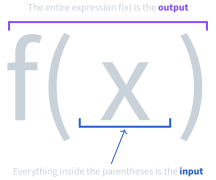
The graph of a function $y = f(x)$ is all points $(x, f(x))$ in the coordinate plane.
A curve in the plane is the graph of a function if no vertical line intersects the curve more than once.
The domain is the set of all possible inputs to a function.
The range is the set of all possible outputs of a function.
Imagine squishing the graph towards the $x$-axis:
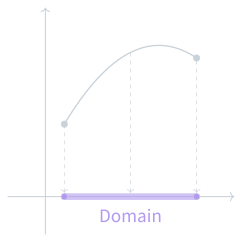
A demand function is a relationship between the price $p$ and the quantity $q$ of a good that can be sold (that is demanded). We have seen $q = f(p)$ but later we will see $p = f(q)$.
The $x$-intercept of a graph is the $x$-coordinate where the graph intersects the $x$-axis.
The $y$-intercept of a graph is the $y$-coordinate where the graph intersects the $y$-axis.
To solve $f(x) = 0$, graph $f(x)$ and find the $x$-intercepts.
1.2: Operations on Functions
Given two functions $f(x)$ and $g(x)$, the composite function is $(f\circ g)(x) = f(g(x))$.
1.3: Linear Functions and Average Rate of Change
The function $f(x) = mx + b$ is a linear function whose graph produces a line.
$m$ is the slope and $b$ is the $y$-intercept.
The equation of a line with slope $m$ passing through the point $(x_1, y_1)$ is \[y - y_1 = m(x - x_1)\]
The average rate of change (AROC) of $y = f(x)$ on the interval $[a, b]$ is \[\text{ARoC} = \dfrac{\text{change in } y}{\text{change in } x} = \dfrac{f(b) - f(a)}{b - a}\]
The ARoC is the slope of the secant line through $(a, f(a))$ and $(b, f(b))$.
The difference quotient of a function $y = f(x)$ is the expression \[\dfrac{f(x+h) - f(x)}{h}\]
The difference quotient is the AROC on the interval $[x, x+h]$.
When finding the difference quotient, the global structure will (after some algebra) be global factors \[\dfrac{h\cdot (\text{stuff})}{h}\] where the $h$ cancels.
1.4: Exponents
The $n$th power of $a$ is \[a^n = a\cdot a \cdot \cdots a\]
Exponents are shorthand for multiplication (factors).
Zero and negative exponents are defined as \[a^0 = 1 \qquad \qquad a^{-n} = \dfrac{1}{a^n}\]
1.5-1.6: Polynomial and Rational Functions
A quadratic function has the form $f(x) = ax^2 + bx + c$ with $a \neq 0$.
A polynomial function of degree $n$ has the form \[f(x) = a_nx^n + a_{n-1}x^{n-1} + \cdots + a_1x + a_0 \qquad a_n \neq 0\] where $n$ is an integer.
A graph is continuous if you can draw it without lifting your pencil.
A vertical asymptote is a vertical line $x = a$ where the heights $f(x)$ approaches $\pm\infty$ as the inputs approach $a$.
A horizontal asymptote is a horizontal line $y = b$ where the heights $f(x)$ approaches $b$ as the inputs approach $\pm\infty$.
A rational function is a function that is a ratio of two polynomials $P(x)$ and $Q(x)$: \[f(x) = \dfrac{P(x)}{Q(x)} = \dfrac{a_nx^n + a_{n-1}x^{n-1} + \cdots + a_1x + a_0}{b_mx^m + b_{m-1}x^{m-1} + \cdots + b_1x + b_0}\]
For a rational function $f(x) = \dfrac{P(x)}{Q(x)}$, the vertical asymptotes occur at the solutions of $Q(x) = 0$.
1.7: Exponential/Logarithmic Functions
An exponential function has the form \[f(x) = a\cdot b^x\] where $a\neq0, b> 0$ and $b \neq 1$.
$e \approx 2.718281828$
$e$ is Euler's number; used as the base of exponential functions frequently.
The logarithmic function with base $b$, written $y = \log_b(x)$ is defined \[\log_b(x) = y \qquad \text{means} \qquad b^y = x\]
Chapter 2: The Derivative
2.0: The Tangent Line
The tangent line at a point on a curve is the line that just "touches" the curve at that point.
2.1: Limits and Continuity
The notation \[\lim_{x\to a} f(x) = L\] means we can make $f(x)$ as close as we want to $L$ by taking $x$ sufficiently close to $a$ but never $a$ itself.
The notation \[\lim_{x\to a^-} f(x) = L\] means we can make $f(x)$ as close as we want to $L$ by taking $x$ sufficiently close to $a$ and to the left of $a$ but never $a$ itself.
The notation \[\lim_{x\to a^+} f(x) = L\] means we can make $f(x)$ as close as we want to $L$ by taking $x$ sufficiently close to $a$ and to the right of $a$ but never $a$ itself.
Given a function $f(x)$, a limit $\displaystyle \lim_{x\to a}f(x) = L$ if and only if \[\lim_{x\rightarrow a^-} f(x) = L = \lim_{x\rightarrow a^+}f(x)\]
A function $f(x)$ is continuous at $x = a$ if and only if \[\lim_{x\to a} f(x) = f(a)\]
2.2: The Derivative
The derivative of a function $f(x)$ at a number $x$ is \[f'(x) = \lim_{h\to 0} \dfrac{f(x+h) - f(x)}{h}\]
Given a function $f(x)$, the equation of the tangent line at the point $(a, f(a))$ is \[y - f(a) = f'(a)(x-a)\]
2.3: Sum and Power Rules
Suppose $a, c$ and $n$ are real numbers and $f(x), g(x)$ are differentiable functions. Then:
2.4: Product and Quotient Rules
Suppose $f(x), g(x)$ are differentiable functions of $x$. Then \[\dfrac{d}{dx}\left(f(x)g(x)\right) = f'(x)g(x) + f(x)g'(x)\] Differentiating a factor structure results in two terms; each factor takes turns receiving the derivative.
Suppose $f(x), g(x)$ are differentiable functions of $x$. Then \[\dfrac{d}{dx}\left(\dfrac{f(x)}{g(x)}\right) = \dfrac{g(x)f'(x) - f(x) g'(x)}{(g(x))^2}\] Differentiating a fraction structure requires the quotient rule.
Use the mnemonic to remember the quotient rule: Low D high minus high D low, square the bottom, away you go!
2.4$\frac{1}{2}$: Business and Economics Applications of the Derivative
The marginal at $q$ items is the change in the revenue, cost, or profit if one more new item is created, putting you at $q + 1$ items.
Given a demand function $p = f(q)$, the total revenue of a business is \[R(q) = q \cdot p = q\cdot f(q)\]
2.5: The Chain Rule
For a composition $y = f(g(x))$, the derivative is \[y' = f'(g(x))\cdot g'(x)\] Using Leibniz notation with $u = g(x)$ and $y = f(u)$: \[\dfrac{dy}{dx} = \dfrac{dy}{du} \cdot \dfrac{du}{dx}\]
The Chain Rule is like peeling an onion: you start from the outside function, and on your way in, every function you encounter must be differentiated while keeping the input the same. For example \[\dfrac{d}{dx}\Big(f(g(h(x)))\Big) = f'(g(h(x)))\cdot g'(h(x)) \cdot h'(x)\] Every function in the decomposition was differentiated, while keeping the input the same.
2.5$\frac{1}{2}$: Higher Order Derivatives
Given a function $f(x)$:
2.6: Increasing/Decreasing Functions and Concavity
A function $f(x)$ is increasing on an interval when, for any two numbers $x_1$ and $x_2$ in the interval, $x_2 > x_1$ implies $f(x_2) > f(x_1)$.
A function $f(x)$ is decreasing on an interval when, for any two numbers $x_1$ and $x_2$ in the interval, $x_2 > x_1$ implies $f(x_2) < f(x_1)$.
Let $f(x)$ be differentiable on the interval $(a, b)$.
Suppose that $f(c)$ exists, meaning $c$ is in the domain of $f(x)$.
Then $c$ is a critical number of $f(x)$ when $f'(c) = 0$ or when $f'(c)$ is undefined (DNE).
To solve an equation with $(\text{factors}) = 0$, set each factor to $0$ and solve each equation.
For example, if $A\cdot B = 0$, set $A = 0$ and $B = 0$ and solve each equation.
Given a function $f(x)$, follow these steps to determine the intervals on which $f(x)$ is increasing or decreasing:
Suppose $f(x)$ is differentiable on $(a, b)$.
The graph of $f(x)$ is concave upward if $f'(x)$ is increasing on $(a, b)$.
The graph of $f(x)$ is concave downward if $f'(x)$ is decreasing on $(a, b)$.
Let $f(x)$ be a function where $f''(x)$ exists on $(a, b)$.
Let $f(x)$ be a continuous function.
Then $(c, f(c))$ is an inflection point when $f''(c) = 0$ or when $f''(c)$ is undefined (DNE).
Given a function $f(x)$, follow these steps to determine the intervals of concavity:
2.7: Optimization
Let $f$ be defined at $c$.
Given a function $f(x)$, use this test to find the local extrema of $f(x)$:
Suppose that $f'(c) = 0$, and $f''(x)$ exists on an interval containing $c$.
Let $f$ be defined at $c$.
Suppose $f$ is a continuous function defined on a closed interval $[a, b]$. Then $f$ is guaranteed to attain a global maximum and global minimum.
Given a continuous function $f$ defined on a closed interval $[a, b]$, use this method to find global extrema.
2.9: Applied Optimization and Elasticity
Suppose that $c$ is the only critical number of $f(x)$.
Since $P = R - C$, differentiating gives $P' = R' - C'$. Setting $P' = 0$ gives \[R'(q) = C'(q)\] Profit is maximized when marginal revenue equals marginal cost.
Given a differentiable demand function $q = f(p)$, the elasticity of demand is \[E = -\dfrac{p}{q} \cdot f'(p)\]
If the price increases by 1%, the demand will decrease by $E$%.
Note: The demand function must be written as $q = f(p)$ (quantity as a function of price) to calculate elasticity.
$E$ is a dimensionless quantity: \[E = -\dfrac{p}{q} \cdot \underbrace{\dfrac{dq}{dp}}_{\text{units/\$}} = \dfrac{\%\text{ change in quantity demanded}}{\%\text{ change in price}}\]
2.11: Implicit Differentiation and Related Rates
An equation is in implicit form when $y$ is not isolated. For example: \[xy = 1 \qquad y^3 + y^2 - 5y - x^2 = -4 \qquad x^2 + 4y^2 = 4\]
To find $\dfrac{dy}{dx}$ for an equation in implicit form:
The derivative $y'$ from implicit differentiation gives the slope of the tangent line at a point $(a, b)$ on the curve. Plug in both $x = a$ and $y = b$ to evaluate the slope.
When two or more quantities change over time and are related by an equation, their rates of change are also related.
Important: Do not plug in numbers before Step 3!
Chapter 3: The Integral
3.1: The Definite Integral
The sum \[\sum_{i=1}^{n} a_i = a_1 + a_2 + \cdots + a_n\] where $i$ is the index, which starts at the number below the sigma and increases by 1 until it equals the number above the sigma.
Using $n$ rectangles, the approximate area between the graph of $f(x)$ and the horizontal axis on $[a, b]$ is the Riemann sum \[\sum_{i=1}^{n} f(x_i) \cdot \Delta x\] where
The definite integral of $f(x)$ from $a$ to $b$ is the limit of the Riemann sum: \[\int_a^b f(x)\, dx = \lim_{n \to \infty} \sum_{i=1}^{n} f(x_i)\, \Delta x\] where
Each symbol in $\displaystyle\int_a^b f(x)\, dx$ represents an idea from the Riemann sum:
The definite integral $\displaystyle\int_a^b f(x)\, dx$ computes signed area between the curve of $f(x)$ and the horizontal axis:
If $f(x)$ represents a rate of change, then the area underneath the curve (the definite integral) represents the total amount of something.
3.1$\frac{1}{2}$: Antiderivatives
Given a function $f(x)$, the function $F(x)$ is called an antiderivative of $f(x)$ if \[F'(x) = f(x)\]
All particular antiderivatives of $f(x)$ differ only by a constant. The general antiderivative of $f(x)$ is \[F(x) + C\] where $C$ is an arbitrary constant.
3.2: Fundamental Theorem of Calculus and Indefinite Integrals
If $f(t)$ is continuous on $[a, b]$, then the function \[g(x) = \int^x_a f(t) \ dt, \qquad a \leq x \leq b\] is also continuous on $[a, b]$, differentiable on $(a, b)$, and $g'(x) = f(x)$.
If $f(x)$ is continuous on $[a, b]$, then \[\int^b_a f(x) \ dx = F(b) - F(a)\] where $F(x)$ is any antiderivative of $f(x)$.
If $F'(x)$ is a rate of change, then \[\int^b_a F'(x) = F(b) - F(a)\] gives the net change of $F(x)$ on $[a, b]$.
Given a function $f(x)$, the indefinite integral of $f(x)$ is the general antiderivative of $f(x)$: \[\int f(x) \ dx = F(x) + C\] where $F'(x) = f(x)$.
Suppose $a, c$ and $n$ are real numbers and $f(x), g(x)$ are differentiable functions. Then:
3.4: Integration By Substitution
Suppose $u = f(x)$ is a differentiable function. The differential of $x$ (denoted by $dx$) is any nonzero number. The differential of $u$ (denoted $du$) is $du = f'(x) \ dx$.
When integrating a function that involves a composition $f(g(x))$, set $u = g(x)$, or the inside of the composition. The differential of $u$ is $du = g'(x) \ dx$. We substitute: \[\int f'(g(x))\cdot g'(x)\ dx = \int f'(u)\ du\]
When using $u$-substitution on a definite integral, convert the bounds of integration from $x$-values to $u$-values. No back-substitution is needed: \[\int^b_a f'(g(x)) \cdot g'(x) \, dx = \int^{g(b)}_{g(a)} f'(u) \, du\]
3.5: Integration By Parts
Given an integrand with two factors, choose $u$ and $dv$. Then: \[\int u \, dv = uv - \int v \, du\] For definite integrals: \[\int^b_a u \, dv = uv \bigg\rvert^b_a - \int^b_a v \, du\]
From your choice of $u$, you find $du$ (differentiate). From your choice of $dv$, you find $v$ (integrate).
Let $n$ be an integer. Use this table to identify which method is appropriate.
| Integral | Method | Why |
|---|---|---|
| $\displaystyle\int \ln(nx) \, dx$ | $u$-sub | Set $u = nx$, isolate $dx$ |
| $\displaystyle\int x^n \ln(x) \, dx$ | IBP | $u = \ln(x)$, $dv = x^n \, dx$ |
| $\displaystyle\int \dfrac{\ln(x)}{x} \, dx$ | $u$-sub | Set $u = \ln(x)$, $du = \frac{1}{x}\,dx$ matches |
| $\displaystyle\int \dfrac{1}{x\ln(x)} \, dx$ | $u$-sub | Set $u = \ln(x)$, $du = \frac{1}{x}\,dx$ matches |
| $\displaystyle\int x^n e^x \, dx$ | IBP | $u = x^n$, $dv = e^x \, dx$ |
General advice:
3.6: Area and Average Value
If $f$ and $g$ are continuous on $[a, b]$ and $f(x) \geq g(x)$ for all $x$ in $[a, b]$, then the area of the region bounded by $f(x)$, $g(x)$, $x = a$ and $x = b$ is \[A = \int^b_a \left[f(x) - g(x)\right] dx\]
Always set up the integral as $\displaystyle\int (\text{top} - \text{bottom}) \, dx$. Look at the graph to determine which function is on top.
If $f(x)$ is continuous on $[a, b]$, then the average value of $f$ on $[a, b]$ is \[\dfrac{1}{b - a}\int^b_a f(x) \, dx\]
$\displaystyle\int^b_a f(x) \, dx$ is a sum of infinite rectangular areas (height $\times$ width). Dividing total area by total width $b - a$ gives average height.
3.7: Business Applications of the Integral
The equilibrium point $(q^*, p^*)$ is where the demand and supply curves intersect. To find it, solve $D(q) = S(q)$.
$p^*$ is the equilibrium price: where the plans of consumers and producers agree, meaning the amount of product consumers want to buy equals the amount producers want to sell. $q^*$ is the equilibrium quantity.
Given a demand function $p = D(q)$, supply function $p = S(q)$, and equilibrium point $(q^*, p^*)$:
Consumer surplus measures "how much of a deal you got" at the aggregate level. Both CS and PS are areas between two curves on $[0, q^*]$, computed as $\displaystyle\int (\text{top} - \text{bottom}) \, dq$.
If $F(t)$ represents a continuous income function (in dollars per year), and the nominal interest rate is $r$ (in decimal form), then over $T$ years:
A dollar today is worth more than a dollar in the future, because today's dollar could be invested and grow.
Present value answers: What is the lump sum payment required right now to match the value of the income stream over $T$ years?