Functions Crash Course for Calculus
Goals:
- Describe the object we are going to use calculus on and how it appears in our everyday lives.
- Learn how to mathematically represent a function and manipulate them while avoiding common mistakes.
Functions All Around Us
The word function describes a dependence of one quantity on another. For example:
- The current room temperature is a function of time.
- After a flight takes off, the total distance a plane travels is a function of time since takeoff.
Functions should be thought of as a machine.
For example, when you input time, you get out the current temperature. Any temperature app you have uses this idea.
Notice that at a single time point, only one output is returned. This leads us to the mathematical definition of a function.
Evaluating a Function
A simple way to mathematically represent input-output is with the notation $f(x)$.
Here, the $x$ between the parenthesis is your input variable, and $f(x)$ is your output.
- $f(0)$
- $f(-1)$
- $f(-a)$
- $f(x + h)$
- $f(x + h) - f(x)$
Beware: everything between the parenthesis must be treated as input.
From now on, when instructed to perform something, like "evaluate $f(x + h)$" you must fully simplify.
For example, this can mean:
- expand then combine like terms whenever you can
- use Fraction Law 5 to cancel factors if applicable
- multiply all fractional expressions together to write your answer as one fraction
- etc.
- $g(0)$
- $g(-1)$
- $g(-a)$
- $g(x + h)$
- $g(x + h) - g(x)$
Domain of a Function
The domain of a function is the set of all inputs you can input to get out a valid real number.
- $-2$
- $-1$
- $0$
- $\frac{1}{2}$
- $2$
When finding domain, follow two steps:
- Look for problems. These are numbers, when evaluated, result in something that is not a real number. Problems are
- Plugging a number where you end up dividing by zero.
- Plugging a number where you end up taking the square root of a negative number.
- Remove the problems from $\mathbb{R}$ and write your answer in interval notation.
Piecewise Functions
Piecewise functions are functions where you have multiple different functions on different parts of the domain.
For example, \[f(x) = \begin{cases} x^2 & x \leq 1 \\ -2x + 3 & x > 1\end{cases}\] is a piecewise function.
Here's how to read this: If your input $x$ is less than or equal to 1, then you need to plug it into $x^2$.
If your input $x$ is strictly greater than 1, plug it into $-2x + 3$.
Graph of a Function
You can describe a function like \[f(x) = x^2 + 2\] in four different ways.
- In English: Square the input and add two
- Algebraically: $x^2 + 2$
- With a table of values
- With a graph in the coordinate plane
The graph is especially important because you can quickly spot visual patterns in certain types of functions.
It also gives us an intuitive understanding of calculus concepts instead of just looking at a bunch of messy algebra like \[f(x) = \sin(x)\tan(x)e^{4x}(x^4 - x^2)\]
Base Functions to be Familiar With
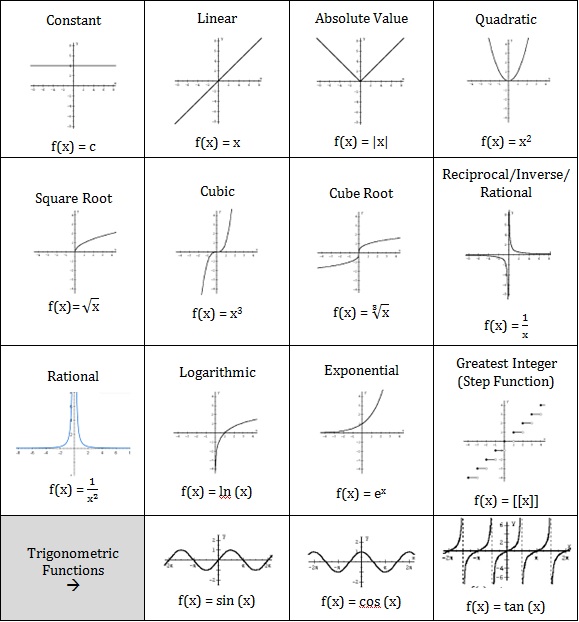
In calculus, you need to be familiar with what we call "parent functions:" linear, absolute value, polynomial, rational, exponential, logarithmic, and trigonometric functions.
These are all part of the prerequisite of MATH 141.
Here are good resources if you need a refresher of these types. I recommend the textbook Precalculus, Mathematics for Calculus by James Stewart, 7th Edition.
- For polynomials: pages 246-256 in Precalculus
- For rationals: Section 3.6 in Precalculus (pages 295-307)
- For exponentials: Section 4.1 and 4.2 in Precalculus (pages 330-334, 338-339)
- For logarithms: Section 4.3 and 4.4 in Precalculus (pages 344-358)
- For trigonometric functions:
Moreover, Section 1.2 in our Calculus textbook contains a very terse summary of all of these function types. If you do not remember the details of a logarithm, for example, I recommend the above list as another reference.
Here's a visual guide to a few parent functions we'll encounter.
Holes
When you cancel a common factor in a rational function, you must exclude the zero of that factor from the domain.
Such a factor is called a hole.
Creating New Functions with Operations
$+, -, \times, \div$ functions together is done by performing the specified operation on the function output. Let's look at some examples.
Be careful when you are subtracting and multiplying functions together. If you are multiplying by $\geq 2$ terms, do not forget parenthesis.
- $f(x)+g(x), f(x)-g(x), f(x)g(x), \frac{f}{g}$ and their domains
- $\left(\frac{f}{g}\right)(0)$
- Let's first find the domains and intersect them. Both functions have domain $\mathbb{R}$. Following the above table, we see that \begin{align} (f+g)(x) &= f(x) + g(x) &&= x^2 + x + -x^2 - x = 0 \\ (f-g)(x) &= f(x) - g(x) &&= x^2 + x - (-x^2 - x) = x^2 + x + x^2 + x = 2x^2 + 2x \\ (f\cdot g)(x) &= f(x)\cdot g(x) &&= (x^2 + x)(-x^2 - x) = (x^2 + x)(-x^2) + (x^2 + x)(-x) = -x^4 - x^3 - x^3 - x^2 = -x^4 - 2x^3 - x^2 \\ \left(\frac{f}{g}\right)(x) &= \frac{f(x)}{g(x)} &&= \frac{x^2 + x}{-x^2 -x} = \frac{x(x+1)}{-x(x + 1)} = \frac{1}{-1} = -1 , \ x \neq 0, x \neq -1 \\ \end{align} To be clear, \[\dfrac{f(x)}{g(x)} = -1 , x \neq 0, x \neq -1\] Notice the domain exclusion (caused by cancelling factors) where your input $x$ cannot be $0$ nor $-1$. Since $\mathbb{R} \cap \mathbb{R} = \mathbb{R}$, all functions have domain $\mathbb{R}$.
- From part 1, the definitions of $f+g$ and $f/g$ give \begin{align} (f+g)(4) &= f(4) + g(4) &&= \frac{1}{4-2} + (4 - 3) & = \frac{3}{2} \\ \left(\frac{f}{g}\right)(4) &= \frac{f(4)}{g(4)} &&= \frac{1}{(4-2)(4 - 3)} &= \frac{1}{2} \\ \end{align} Since we cannot divide by zero, $\left(\frac{f}{g}\right)(3)$ is undefined.
Function Composition
Function evaluation on a number is straightforward: the preceding example utilized this concept. What if we evaluate a function on another function? This idea is called function composition.
To evaluate a function composition, you first plug in $g(x)$ into $f(x)$, and wherever there is an $x$ in $f(x)$, substitute the definition of $g(x)$ there.
- This shows that the operation $\circ$ is not commutative, i.e. $f\circ g \neq g \circ f$. Do not mistake $f\circ g$ to mean function multiplication!
- We can also take compositions of three or more functions. For example, $f\circ g \circ h = f(g(h(x)))$.
The concept in these last two composition examples will be used extensively in calculus.